Tag Archives: Apple

Migrating to Ente Auth – Export TOTP tokens from Authy

Authy Logo

I’ve recently had to migrate all my 2FA codes (TOTP tokens) from Authy.  For those that don’t know, Authy had a breach (here, and here)  a while ago, and since then seemingly put a stop to development of their desktop apps, and also migrating and /or syncing newly added tokens. They were essentially taking our tokens hostage. It became a bit of a precarious situation, as the only app that would still work was the mobile app, but at the same time it wouldn’t let you download and configure the new app on another device (I don’t think…) or have tokens backed up and syncing across multiple devices.

The primary reason for me to use Authy before was so that I could access my 2FA codes from multiple computers and mobile devices. Without this functionality, it was pretty pointless.  Even when they ended their native support of the desktop apps, you could still run the iPad version on Apple Silicone until they blocked that too. A real shame!

I had a couple of options to get round this.

1. Reset all my 2FA sessions and generate new tokens all over. This is a pain as I had well over 20 and this would take some time.

2. Find a way of exporting the tokens using various methods worked on in the open source community. These involve many technical steps but the processes are documented. They involve man in the middle snooping and Python scripts. All in all, a bit of fun.  I’m technically minded so no problem!

I had done some research and found Ente to be a great open-source alternative to migrate to.  The new solution also features end to end encrypted backup, as well as multi-platform and device support.

Ente Logo

The migration itself took some time and some prior preparation.

The steps I followed are on the following GitHub Gist – https://gist.github.com/gboudreau/94bb0c11a6209c82418d01a59d958c93

Not every scenario will work for you, so read the documentation fully.

The exact steps I followed are these: https://gist.github.com/gboudreau/94bb0c11a6209c82418d01a59d958c93?permalink_comment_id=5298931#gistcomment-5298931

Since I followed the steps, there has been a revised and simplified version, which I would probably recommend you follow instead: https://github.com/BrenoFariasdaSilva/Authy-iOS-MiTM

All in all this was an interesting experience, which allowed me to learn something new, play with Python, and man in the middle proxy, to catch data being transferred and intercepting it. The software MITMProxy, can be used for a multitude of other things.  Something to write about another day!

Ente also develop an alternative to Apple Photos or Google Photos, worth checking out if you’re not a fan of either.


HOW TO: Improve the performance of your older laptop!

laptop

Just because your laptop is a few years old doesn’t necessarily mean you have to go and buy a new one, especially not if the hardware specification is fairly reasonable. If it can still run the latest operating system, for example, and you’re not interested in playing games on it, then read on.

The quickest and easiest way to give your laptop a speed boost is by upgrading the memory (RAM). In almost all laptops, manufacurers make it very simple for you to do this yourself in a matter of minutes, using only a screwdriver to remove an access panel.

The market leader in this (and we’re not affilliated) is Crucial. If you click onto their website you can run a tool which detects which laptop you have – be it Apple or Windows based – and tell you what memory you can fit. They tend to be the cheapest most of the time too. The tool will return results telling you how much additional memory your laptop can muster. If the version of Windows is 32 bit, upgrading your laptop to more than 4GB of memory will not make any difference as the computer won’t be able to “see” the additional memory.

The next step is looking at the hard disk. The cheapest laptops and even more expensive laptops by default still have spinning hard disks. Depending on the speed at which the disk spins at, will determine how fast the read and write speeds are.

Newer technology has since surpassed traditional spinning disk drives, and prices have come down massively. This technology is what you find in your mobile phone and tablet, and what enables most devices like that to be “instant on”, and is called Solid State Disk (SSD) as there are no moving parts. A lot of the time, this is why when you go back to your traditional laptop, you find yourself waiting much longer for things to load. It is a little bit more intrusive to replace and swap out your hard disk. You need to clone, or reinstall, your Operating System and copy the files back. There are guides for this, but we recommend you contact someone to look at this for you. The price of an SSD is somewhere in the region of £80-100 but prices are falling all the time.

Feel free to contact us if you would like assistance with replacing memory or your hard disk to give life to an older computer.

iPhone not charging? Check this quick fix.

The number of times your iPhone may not be charging due to it actually being faulty is fairly minimal, and more often than not, it’s the cable at fault and not the phone itself.

The iPhone 6 we have wasn’t charging and after checking the obvious we then hit Google. Some articles later, and we were lead to check if lint wasn’t to blame.

Sure enough, if you hit search you see the following results:

Lint Google Search


The essence of it is to make sure your iPhone is backed up, turn it off, and then use a normal toothpick to pick out any fluff and stuff that the Lightning port has attracted from your trouser pocket.  In our case this fixed the problem!

Better still, it cost nothing 🙂

For more info you can read the following: https://www.cnet.com/how-to/use-a-toothpick-to-clean-out-your-iphone/

How to accept hassle free Direct Debit and card payments

For us, it is really frustrating to see businesses who are still operating but unable to take card payments or direct debit payments for recurring or subscription based products.

We are going to introduce a couple of solutions on this post.

We are not affiliated with either business and only writing this post to help other like minded small businesses and hope you find the information useful.

  1. Go Cardless. If your business offers regular and recurring invoices for services or products that are charged weekly, monthly, or annually then this service will probably be a good fit for you.

We use this service as it’s integrated with our accounting platform Quickfile.  You can set it up easily to receive payments from customers on your invoices. It gives us the opportunity to set up the payment via Direct Debit.

For more information and to see an overview click here


2.  SumUp. If you want to take card payments with no subscription or line rental, wherever you are (great for stationary stores or for mobile sellers, market stalls, pop up shops and more) then this solution is great.

Albeit, the majority of payments we take are still by cheque (or PayPal), we do have and use the app provided by SumUp occasionally. It ties in well with our accounting software, see above, and allows you to take card payments with no hassle whatsoever.

There are some restrictions, such as countries you can use the product, but for the UK, there is no problem at all.

When we first signed up, there was no requirement for the card reader, and I believe we still have the original product, so have to check if that still works… will update the blog when I have checked!

Ultimately, there is no reason at all, why any business has to limit itself by not accepting direct debit or card payments! Both the above provide mobile apps for Apple and Android and therefore catering for just about anyone.

Running Mavericks with Parallels Desktop 8 for Mac

osx_hero_2xI made it my aim this week to set up Mavericks, the new release of OS X, within a Parallels VM.

Firstly, I was trying to get it running without the newly announced client.

I had read the KBs on the Parallels web site which announced that you couldn’t install the new OS from a DMG directly but you had to have a VM with OS X 10.8 to then upgrade before going ahead (you can find that KB here).

Below are the steps I took.

1. Downloaded the NEW Parallels client designed to support Mavericks. This was version

Build 8.0.18494 / (Revision 886912; June 17, 2013).

Download Here.

2. Install OS X Mountain Lion. You can do this quite easily using the Parallels wizard (it uses the installer from the recovery partition). Make sure all updates are installed.

3. Download the Mavericks 10.9 Developer Preview and copy this to the Mountain Lion VM.

4. Very Important -> Move the Mavericks installer app to the ApplicaMavericks in Parallelstions folder on the Mountain Lion VM.

5. Run the Mavericks installer app from Applications in your Mountain Lion VM; run through the installer, selecting Macintosh HD as the disk to install to. It will begin the installation and will restart. This takes some time. It took me about an hour.

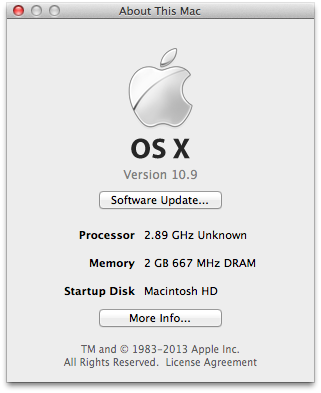
6. That should be it, your OS X VM should have now restarted and updated correctly to Mavericks.

Please do leave comments and I will try my best to help where possible.